
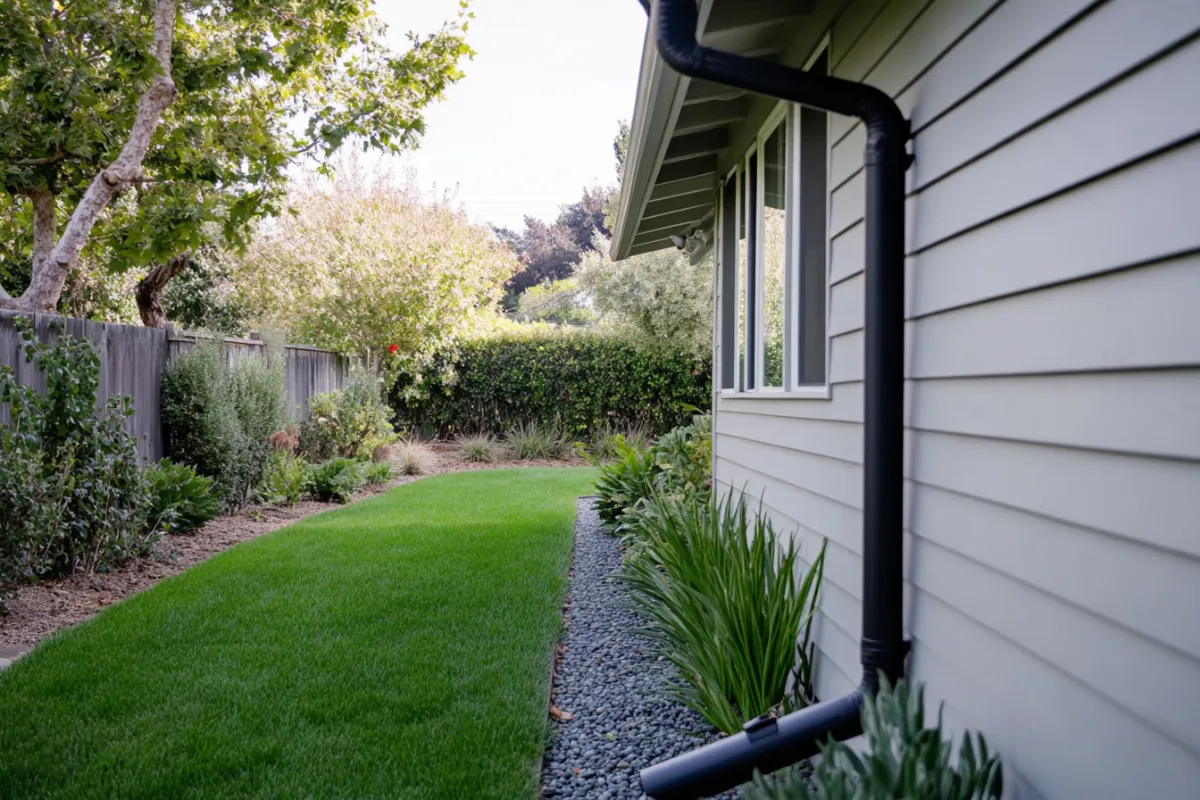
Every gallon your gutters catch has to come down somewhere, and that somewhere is usually right next to the house. A downspout that empties onto a splash block a foot from the foundation puts the water back where the gutter was supposed to keep it from going. Over a few winters that can mean a wet crawl space, a cracked walkway, or soil washing out from under a patio. On the steep lots above San Rafael and on the hillsides around Mill Valley, it can also mean water running across the slope and taking soil with it. Good drainage is about getting the water to the right place, at a pace the ground can handle.
Below, we walk through the signs your drainage isn't doing its job, the different ways to move water away from a house, how we plan and install a drainage fix, and how hillside lots change the approach. Drainage works best with gutters that are sized and pitched correctly, so take a look at seamless gutter installation if yours are undersized or worn out. New gutters and better downspouts are often one project.
Signs Your Downspouts Aren't Working
Start at the bottom of each downspout. If the ground there is eroded, bare or always soggy, the water isn't moving far enough. Puddles that sit along the foundation after a storm are a bad sign, and so is a musty smell or standing water in the crawl space. Look for cracks in concrete walks and patios next to downspouts, since repeated soaking and drying can move the soil underneath. Mulch and gravel washed into the lawn point to the same thing. Inside the gutter, a downspout that backs up during heavy rain is either clogged or undersized for the roof area feeding it. And if you have just one or two downspouts on a long roofline, there probably aren't enough.
Extensions, Splash Blocks, Underground Drains and Dry Wells
There are a few ways to move water, and the right one depends on the yard. Splash blocks are the simplest. They spread water out at the base of the downspout but don't carry it far. Downspout extensions, rigid or flexible, carry water several feet out, ideally five or more, before it hits the ground. They're cheap and effective, but they can get in the way of mowing and walking. Underground drains connect the downspout to a buried pipe that runs out to a better spot, such as a lawn, a garden bed or a gentle slope away from the house. Dry wells are buried gravel or plastic chambers that hold water and let it soak into the soil slowly. Many Bay Area cities encourage sending roof water into landscaped areas rather than the street, which can shape the plan.
Free estimate, no obligation.
Call (415) 891-0258How We Plan and Install a Drainage Fix
We start by looking at the whole roof, not just one downspout. How much roof area drains to each outlet, where the water lands now and where the ground slopes. Sometimes the fix is as simple as adding a downspout to split a long run, moving one to the other end of the gutter, or upsizing from 2x3 to 3x4-inch. Other times it means extensions or an underground line to carry water away. For buried drains, we trench along a route that keeps a steady downhill slope, use solid pipe so it doesn't clog with soil, and finish with a pop-up emitter or an outlet at a safe spot. Then we test it with a hose and watch where the water goes.
Drainage on Hillside Lots
Hillside houses make drainage trickier. Water from an uphill roof doesn't just need to leave the foundation. It needs to go somewhere that won't send it down the slope as a fast, concentrated stream, which can cut into the soil and undermine retaining walls, steps and the neighbor's yard below. On slopes, we look at where water naturally collects and try to spread it out or slow it down rather than dump it in one spot. That might mean splitting flow between several downspouts, sending it to a landscaped area that can absorb it, or connecting to an existing drainage system. For bigger hillside drainage problems, especially near retaining walls, we'll tell you when the job calls for a civil engineer or a drainage specialist.
Drainage problems often show up first as clogged downspouts, which is why our gutter cleaning visits include flushing every one.
Common Questions
A common rule of thumb is at least five feet from the foundation, and farther is better where the ground is flat or slopes back toward the house. On a slope that falls away from the house, a shorter extension may be enough. The real test is what happens in a storm: water should land on ground that drains away from the house and soaks in, without pooling against the foundation or running onto walkways.
In most cases, yes. We connect the downspout to a buried, solid pipe that runs at a steady downhill slope to a safe outlet, like a pop-up emitter in the lawn or a spot in the yard that can take the water. We avoid sending roof water toward the neighbor's property or onto a steep slope. Some cities have rules about connecting to the street or storm drain, so we check what applies to your address first.
Possibly. A long gutter with a single downspout at one end has to carry all of that roof's water through one outlet, and in a heavy storm it can back up and overflow. As a general guide, one downspout for roughly every 30 to 40 feet of gutter works on most homes, more on big or steep roofs. Upsizing from a 2x3-inch to a 3x4-inch downspout also moves a lot more water without adding another one.