
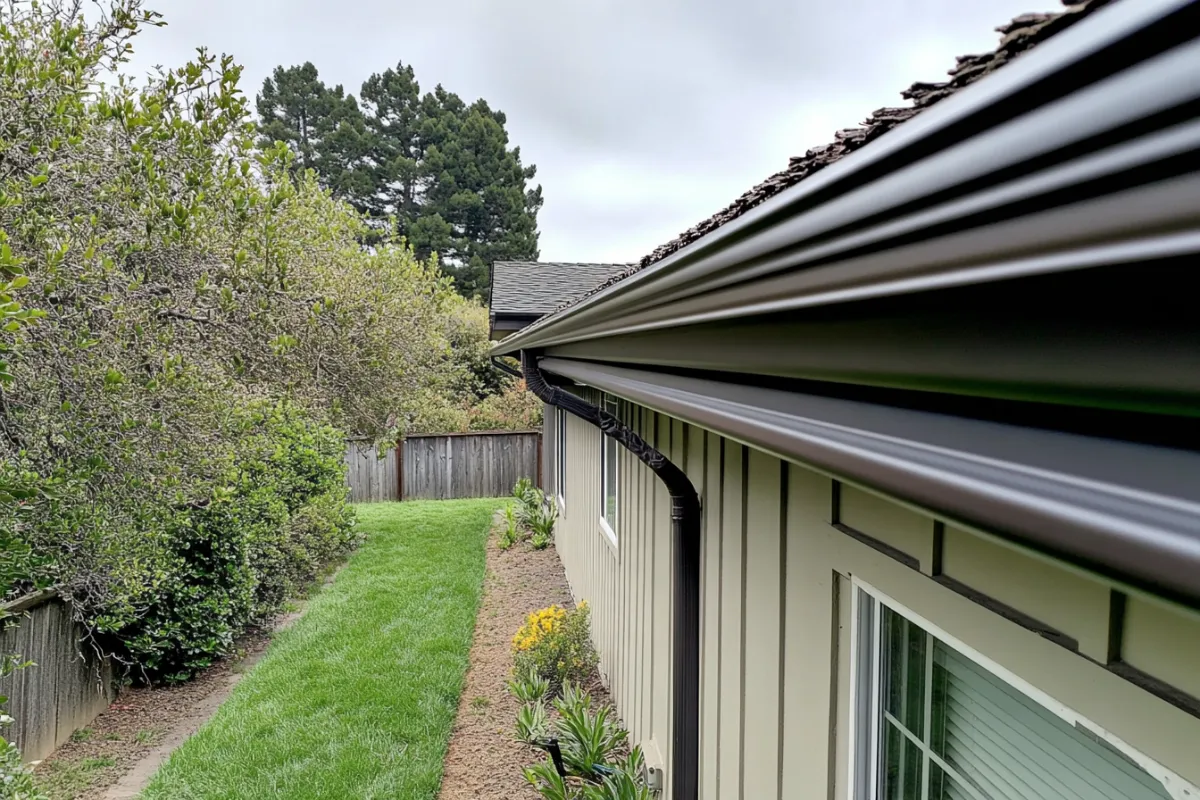
Most gutter leaks start at a joint. Sectional gutters come in short lengths that get snapped together and sealed, and after a few winters that sealant dries out, cracks and starts to drip right onto the fascia. Seamless gutters skip the problem. We bring a forming machine and a coil of metal to the house, and each run comes out as one continuous piece, sized on the spot to that roof edge. The only joints left are at the corners and where the downspouts drop. On a ranch house in San Rafael that might mean four or five long runs. On a hillside home in Larkspur with a lot of rooflines, it can be a dozen shorter ones, each made to fit. Either way, nothing gets ordered in stock lengths and trimmed to almost fit.
Below, we cover the signs that tell you your current gutters are done, which size and material make sense for a Marin house, exactly how an install day goes, and how to keep new gutters working for decades with very little effort. If your old system is already failing and you're weighing a fix against a full swap, our gutter replacement page walks through that decision.
Signs It's Time for New Gutters
Some gutters announce it. Water sheets over the front edge during a hard rain, or a whole section sags away from the house. Others fail quietly. Look for drip lines or rust streaks on the siding below a seam, peeling paint on the fascia board, or a strip of soil along the foundation that's washed lower than the rest of the bed. Check the corners too. Mitered corners on sectional systems are the first place sealant lets go. If your gutters are the original ones on a house built in the 1970s or 80s, and plenty in Marin are, they've likely outlived their design life. One overflow in a downpour isn't a death sentence. A pattern of them usually is, and the longer it runs, the more of the fascia and siding it takes with it.
K-Style, Half-Round and Getting the Size Right
Most homes get K-style gutters. Viewed from the end, the front face has a decorative curve that looks a bit like crown molding, and the flat back sits tight against the fascia. Half-round gutters are a simple half circle. They suit older homes, craftsman houses and copper installs, and you'll see them on a lot of older shingle-style houses around Marin. Size matters more than style. A standard 5-inch gutter handles most single-story roofs. A 6-inch gutter carries roughly 40 percent more water, which makes sense for big roof areas, steep pitches and homes under trees. Material is mostly aluminum, in .027 or the heavier .032 gauge. Copper costs several times more but can last the life of the house. Color matters too: aluminum comes prefinished in dozens of colors, so it can match your trim instead of fighting it.
Free estimate, no obligation.
Call (415) 891-0258How Installation Day Works
We start by taking down the old gutters and checking every foot of fascia behind them. Soft or rotted boards get flagged and, with your OK, replaced before anything new goes up. Then we measure each run again and form the gutter on site. Each section gets a slight pitch toward its downspout, usually about a quarter inch for every 10 feet, so water keeps moving instead of pooling. We fasten it with hidden hangers spaced about every two feet. They sit inside the gutter, so you don't see them from the street, and they hold far better than old spike-and-ferrule mounts. Downspouts go on last, then we run water through the system to make sure it drains. If anything pools or drips, we adjust it before we pack up.
Keeping New Gutters Working
Seamless gutters don't need much, but they do need something. Plan on a cleaning at least once a year, ideally in late fall after the oaks and maples drop, and twice if you have pines or redwoods over the roof. While you're up there, or while we are, look at the downspout outlets, since that's where clogs start. Check that the hangers are still tight after a big windstorm. And keep an eye on where the downspouts empty, especially after landscaping changes around the house. A gutter that works perfectly still causes trouble if it empties hundreds of gallons into a flower bed against the foundation. A well-installed aluminum system in Marin's mild climate can easily give you 20 years or more.
If you'd rather clean less often, ask us about adding gutter guards at install time, when it's easiest to size them to the new gutters.
Common Questions
Most single-story Marin homes do fine with a standard 5-inch K-style gutter. We move up to 6-inch when the roof area draining into one run is large, the pitch is steep, or heavy tree cover means more debris and faster runoff. Downspouts follow the same logic: 2x3-inch for smaller runs, 3x4-inch for bigger ones. We measure and size every run at the estimate, so you're not guessing.
National cost guides put basic seamless aluminum at roughly $6 to $10 per linear foot installed, and Bay Area labor tends to land at or above the high end of that. Two-story work, 6-inch gutters, heavier gauge metal and fascia repair all add to it. Copper is a different category, often several times the price of aluminum. Your written estimate breaks out every one of these so you can see where the money goes.
Yes. Two-story installs take more ladder and safety setup, so they usually cost more per foot and can take a little longer, but the process is the same. Steeper, taller roofs also send water into the gutter faster, so we often recommend 6-inch gutters and larger downspouts on them. Hillside homes with one story on the street side and two or three on the downhill side are common here, and we size each side separately.